
What is the Fetal Exposure to Medicines Service?
The Fetal Exposure to Medicines Service (FEMS) provides expert assessment, advice and care plans for people who are thought to have been affected by exposure to these medicines in the womb.
The service is running a pilot until spring 2027, funded by NHS England and provided by teams at Manchester University NHS Foundation Trust and Newcastle Upon Tyne Hospitals NHS Foundation Trust.
Who can use the service?
Anyone, whether a child or adult, who live in the north of England, who have problems that could be from exposure to an antiseizure medicine in the womb, can be referred by their doctor. It is important to be aware that not all anti-seizure medicines are thought to cause problems for the baby when taken during pregnancy. Information specific to using some of the medicines during pregnancy is at Bumps – Best use of medicines in pregnancy.
What is the referral process?
Children or adults meeting the eligibility criteria can be referred to the service through their GP or other health care professional. The health care professional must complete the referral proforma. The referral, whether it is for the Manchester or Newcastle team, must be sent to the following central email address: Fem.Service@mft.nhs.uk
Referrals will be accepted until the service has reached capacity.
If multiple children, from one family, have been exposed then they can be referred together however one referral proforma must be completed for each person referred.
Note that only patients living in the North of England (Northwest, North East, Yorkshire and Humber) can be referred into this service
FEMS Team
The FEMS team includes clinical geneticists, neuropsychologists, physiotherapists, occupational therapists, speech and language therapists, a care advisor, and clinic coordinators. As this is a pilot service, there is a well-established Patient & Public Involvement (PPI) Group at each hospital site to provide on-going council and advice throughout the pilot.
More information about the service can be read here:
Service at Manchester University NHS Foundation Trust
Service at Newcastle Upon Tyne Hospitals NHS Foundation Trust
Frequently Asked Questions
Q. What is the Fetal Exposure to Medicines Service (FEMS)?
FEMS is a pilot clinical service to provide expert assessment, diagnosis and advice for children and adults who have problems following exposure to certain antiseizure medicines (also known as anticonvulsants) before birth.
The pilot currently covers the North of England only – which equates to NHS England’s Northwest region (incorporating Cheshire, Cumbria, Greater Manchester, Lancashire, and Merseyside).
The service will initially invite referrals for individuals exposed to sodium valproate or topiramate, and over time open to referrals based on the additional medications.
Q. How long does each appointment take?
The first appointment will take around one hour. Further appointments could take up to three hours because they involve meeting with more people or more detailed testing.
Q. Why are there so many different specialists involved?
Diagnosis is not straight-forward, and some symptoms are shared by different health conditions. Each specialist has different expert knowledge, so together they can work out if fetal exposure is likely to explain all or some of your symptoms.
Q. Will there be a blood test?
If a blood test is needed, we will discuss this with you first and explain why it is important. For example, genetic testing is often part of a fetal exposure assessment. We would always explain and agree this with you. Wherever possible, we will use previous test results.
Q. Are x-rays or scans going to be done?
X-rays and scans are not needed for everyone. If they are needed to provide more information about the right treatment or to make a diagnosis, we would explain, and they would only be done if you agree.
Q. Are travel costs covered?
Travel costs are not covered. If you are receiving income support or family credit you can get help with the cost of travelling to and from your appointments. People on a low income may also be entitled to help. Visit healthcare travel costs scheme (HTCS) to find out more.
Q. Will FEMS help with any future legal action?
No. FEMS is an NHS service for health care and would not share your information with any legal teams. We will provide you and your care team with a summary of your assessment with us. It is your personal choice whether to share this information with others.
Q. How do people access the service?
Referrals into the service will generally be via a GP or another clinician (doctor, nurse or therapist) involved with the patient. The health care professional must complete the referral proforma and send to the following central email address: Fem.Service@mft.nhs.uk.
In some cases, it may be appropriate for a person to contact the service direct for an initial discussion about suitability for referral, on the above email.
Q. Can people be referred to FEMS if they do not live in North England?
FEMS is a new pilot service, currently with limited availability. The pilot is initially running in the North of England because the national experts are in Manchester and Newcastle. The pilot will be used by NHS England to inform how service options for the future.
Q. What happens if the pilot service ends before the assessment results are ready?
Anyone seen as part of the pilot, will be contacted by a member of the team to discuss their results and care, even if the pilot has officially ended.
Q. What will happen at the end of the pilot?
NHS England and the pilot programme team will review the findings of the pilot evaluation to inform service options for the future.
Q. Foetal or Fetal?
We use the spelling ‘fetal’ to match with wider healthcare systems. You might also see it spelled ‘foetal’ at other times, which is the British spelling.
Q. What medicines are an anti-seizure medicine?
The pilot covers a list of all medicines used for treating seizures, which has been agreed by experts. If new medicines become available, these will be added to the list. The service will initially invite referrals for individuals exposed to sodium valproate or topiramate, and over time open to referrals based on the additional medications listed HERE.
To be referred to the FEMS clinic a person must have been exposed to one or more of the medicines above and have health problems that might be linked to the exposure.
Helpful links
The following organisations may be helpful for those who have been affected by exposure to these medicines in the womb. Note that we are not affiliated with any charity other than Manchester Foundation Trust Charity.
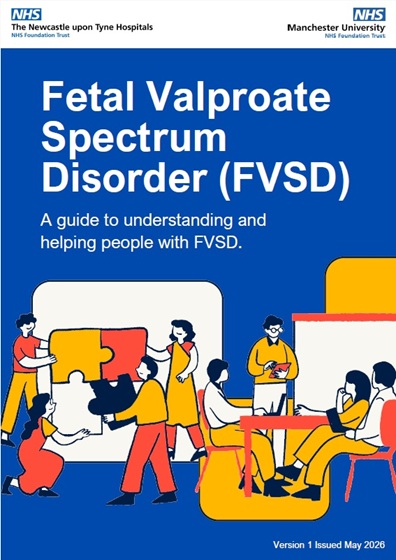
Click on the image to download the FVSD (Fetal Valproate Spectrum Disorder) booklet